How to Recover From an AI Overviews Traffic Drop in 5 Steps
How to recover from an AI Overviews traffic drop: confirm the cause, prioritize the pages that still convert, and rebuild measurement around signals that hold.

On this page
- Introduction
- The recovery sequence at a glance
- The five-step recovery process
- How to confirm AI Overviews caused the drop
- Which pages to fix or protect first
- Restructure content so AI Overviews cite it
- Shift your content mix toward queries AI can’t fully answer
- Rebuild measurement around signals that hold
- Your next move on AI Overview traffic
- Frequently asked questions
Introduction
If rankings stay put and impressions hold while clicks fall, how to recover from an AI overviews traffic drop starts with treating Google as an answer surface. AI Overviews now include external links and they’re sending people into Google AI mode more often, so this is a structural shift where a #1 ranking is worth 58% less the moment an Overview sits above the blue links.
This page is for founders and operators watching organic revenue slip while Search Console still looks healthy. So we walk a 5-step recovery sequence that adapts the system so citations can earn the visit again.
The recovery sequence at a glance
Recover from an AI Overviews drop by confirming the overview is answering your terms, protecting high-value pages first, earning the cited link, covering commercial follow-on demand, and measuring the visits that still convert.
What you need before you start
You need four inputs that show clicks on the affected URLs and which ones still pay. Assemble them before you rewrite a page.
| Prerequisite | Why it matters |
|---|---|
| Google Search Console access | Position and query data for the affected URLs |
| A pre/post date range | The window around when the overview appeared |
| A list of affected URLs | Your recovery queue |
| A value tag per page | Booking, inquiry, or research, so money pages go first |
The recovery steps in order
Run five moves in this order so you keep revenue while Google answers first. Do the diagnosis and the money-page sort before you restructure a single URL.
- Confirm the overview is present on the affected terms while rankings hold.
- Protect and fix the highest-value URLs first, using the value tags.
- Restructure those pages so they earn a cited, linked mention.
- Shift new work toward commercial queries that still need a booking or inquiry.
- Rebuild reporting around leftover visits and citations.
We run that path through our AI orchestration systems so citation keeps working on Google AI mode and ChatGPT. The leftover visitor arrives mid-journey, already treating you as the answer.
The five-step recovery process
We run diagnosis first, then prioritize pages by where the pipeline actually leaks. Confirm the cause, segment the URLs, restructure the ones worth citing, shift the mix, then rebuild measurement. That order is how we get more traffic from AI Overviews when classic visibility is already strong and pickup is still catching up.
Confirm AI Overviews are the cause
Prove the overview is answering your terms while rankings hold.
Match Search Console query and page drops to SERPs that show an overview.
You leave with a frozen URL list that belongs to this recovery.
Segment affected pages by value and failure mode
Split URLs by pipeline value and why clicks fell.
Group ranking pages still catching up versus cited pages with sliding CTR, plus older URLs due a refresh.
Effort goes to the leak that actually costs qualified inquiries.
Restructure high-value pages for citation
Make extractable answers and pull inbound links from your strongest URLs.
Update the structure, refresh the evidence, and drop contextual links from high-authority pages into the ones already showing with weak clicks.
Usefulness and extractability can rise together, which is the fastest-payoff play on pages that already rank.
Shift your content mix
Grow the commercial follow-on layer around terms the overview already answers.
Build comparison pages and experience-led guides that still earn the click.
Organic demand the summary leaves open starts landing on pages built to convert.
Rebuild measurement
Track the visits and citations that still move the pipeline.
Watch organic sessions on protected URLs together with named citations.
Recovery is scored on qualified inquiries and the visits that still arrive.
Step 1: Confirm AI Overviews are the cause
Treat a clicks drop with stable rankings as an answer-surface issue. Capture the queries and URLs where the overview is present so the rest of the work runs on a clean list. We do this before any rewrite because the fix path changes once you know the overview is on the SERP.
Step 2: Segment affected pages by value and failure mode
Split the frozen URL list by pipeline value, then tag the failure mode. Ranking pages with weak extraction get different effort from cited pages with sliding CTR. Here’s the thing: refreshing pages that already rank is the fastest-payoff play, so those URLs go early.
Step 3: Restructure high-value pages for citation
Lead each block with a direct answer, keep headings close to the query, and refresh the evidence. Then pull contextual links from your highest-authority pages into the URLs already showing with weak clicks, so the content is easier to extract and more useful.
Step 4: Shift your content mix
After the ranking URLs are citation-ready, grow content that still earns the click: comparisons, buying-decision pages, experience-led guides. That organic strategy is what compounds while the overview handles the definition query.
Step 5: Rebuild measurement
Tie recovery to qualified inquiries, named citations, and organic sessions on the pages you protected. And watch those together so a quieter SERP still maps to the pipeline.
How to confirm AI Overviews caused the drop
Confirm the cause before you rewrite a page. The first filter is a stable average position and steady impressions, with CTR falling on informational queries because the box finishes the research on the results page.
And do the read query by query over a 3-month window. Site-wide average CTR and average position are weak headline numbers here.
Compare rankings against clicks
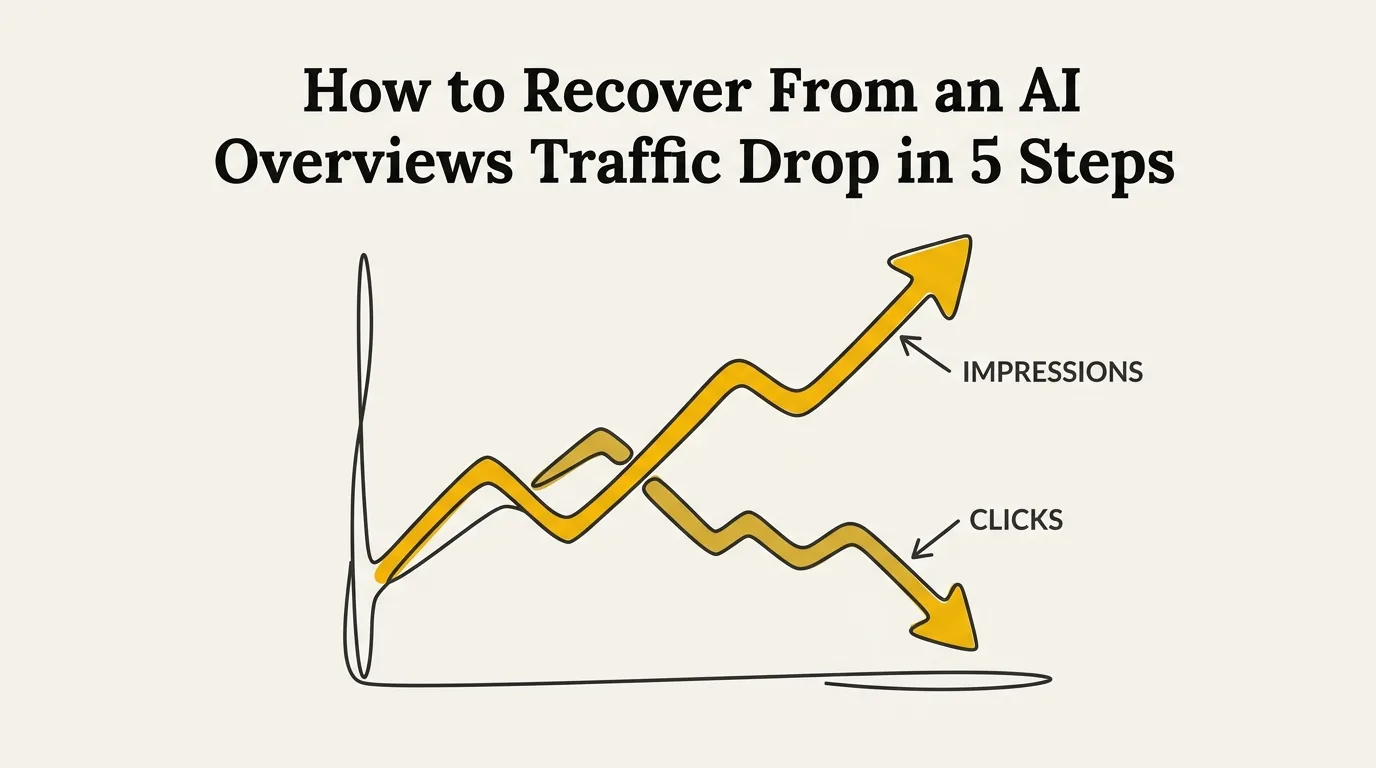
Steady rank with a falling CTR and flat or rising impressions is the Overview pattern. The URL still appears, and the how-to or what-is answer finishes above the listing, so position is a weak predictor of revenue.
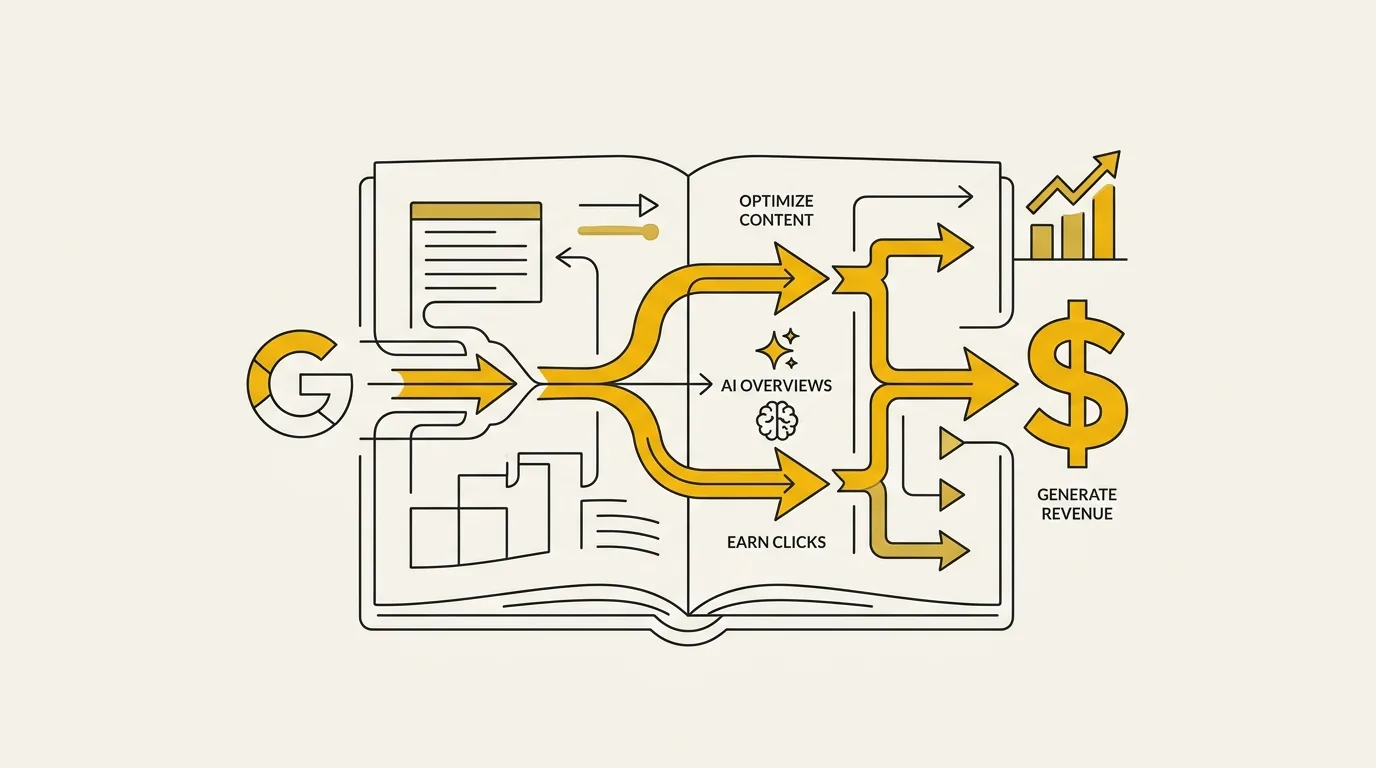
Google can count the impression twice (once in the Overview, once in the blue links), so the impressions vs clicks gap often widens while average position barely moves. Open Performance in Search Console, restrict the view to informational URLs whose average position stayed flat through the drop, then in incognito pair each Overview query with a close twin that still shows standard results, and pull CTR and visits for both groups over the same dates. Overview-led loss shows as a CTR decline on the trigger group while the twins hold.
Rule out algorithm updates and seasonality
Several other issues produce a similar-looking traffic fall. Read each check against the same date range so you keep the Overview diagnosis for the pattern that remains.
- Core updates and position losses show up as a slipping average position, with impressions and visits falling together. Check the position trend and Google’s Search Status Dashboard for an update that matches the dates.
- Penalties show up in Manual Actions in Search Console. Open that report first.
- Reduced demand shows up as impressions and visits falling together while position holds. Check Google Trends on the query cluster.
- Seasonality shows up as a drop that repeats in the same weeks year over year. Compare the prior-year window for the same queries.
- Technical SEO and tracking issues show up as Search Console traffic holding while GA4 sessions fall, or as crawl, index, and Core Web Vitals problems in the same window. Audit the GA4 tag, UTM coverage, and index status first.
Look, CTR tracking can mask where the lost value went even when rank and impressions look fine. Some accounts also see Google Ads move in the same window as organic, which points to SERP layout and answer-box absorption on the whole page. We keep the longer diagnosis of AI Overviews impact on organic traffic for the query-by-query version of this gate.
Which pages to fix or protect first
Protect bottom-funnel and branded pages first. Those URLs still earn clicks after AI Overviews summarize informational queries, while commodity how-to and what-is content sits in zero-click searches.
So score each type by remaining click value and commercial intent. Spend the rewrite budget where a visit can still turn into a booking or inquiry.
| Page type | Still earns clicks | Commercial intent | Recovery effort | Priority |
|---|---|---|---|---|
| Bottom-funnel | ✓ | ✓ | Keep conversion paths | Protect first |
| Branded | ✓ | ✓ | Keep official URLs | Protect first |
| High-value informational | Depth and proof | Decision support | Restructure for citation | Cite next |
| Commodity informational | Answered on SERP | Research intent | Light monitoring | Watch the mix |
Prioritize by impact, confidence, effort, and reversibility
Rank each URL by impact, confidence, effort, and reversibility. Start where a visit can still become an inquiry, and where you can ship a reversible edit this week.
- Impact: booking and inquiry value still attached to the URL after the Overview.
- Confidence: you can name the failure mode before you rewrite.
- Effort: hours to ship a tight, reversible edit.
- Reversibility: you can restore the last live version if CTR stays flat.
Match the fix to the failure mode you named (crawl, index, relevance, CTR, or AI absorption). AI absorption is an answer-shape and follow-on-demand problem, and a citation gap still needs its own call on refresh, structure, internal support, or a new URL.
Restructure content so AI Overviews cite it
We restructure existing pages so a model can lift a clean claim in one pass. Content extractability is the on-page half of that work: the first lines under a heading state the finding, then short sections and tables make the rest scannable.
A common experience is that citation overlap with top organic results can be relatively low, and that citations move even when intent stays stable. In my experience, visibility across ChatGPT, Perplexity, Gemini, and Google AI mode tracks extractable shape more than rank or length. That shape is how a page gets cited inside AI Overviews.
Treat one GEO snapshot as a sample, even when the query intent looks unchanged. Repeat the check before you rewrite a URL around it.
Lead each section with a direct answer
Put a self-contained answer in the first lines under every H2 and H3, around forty words, written so it still holds with the heading stripped. Why forty? So the citation is a complete lift.
Look, word count is a vanity metric. The average cited page is under 1,300 words, and more than half are under 1,000. Write to the question until it is covered, then stop.
Use question-based headings
Split the page into short H2s and H3s that each map to one follow-up question, in the language people actually type. So give each block a single job, then stop.
Headings and bullets give the model clear passage boundaries. FAQ-style blocks do the same job when the page answers follow-ups.
Add tables and decision rules
Add a comparison table when the reader is choosing, and write the rule as a sentence the model can copy. Choose X when Y is the line that gets cited, because it carries the constraint.
Name the threshold and who each option suits. Models quote the pages that spell those tradeoffs with evidence-backed specifics from named sources.
Shift your content mix toward queries AI can’t fully answer
Shift content investment toward queries that still need a side-by-side, a booking path, or a figure only you measured, plus original data and first-hand experience. Those URLs keep earning the visit after AI Overviews summarize the basics.
Keep informational queries current so they build topical authority and hand the reader a commercial next step. So we map the full query fan-out from live Search Console data across a page or a SILO cluster, with the pillar on the main intent and supporting pieces on how-to, listicle, and comparison branches.
When a buyer arrives mid-journey, the first screen carries proof and the choice still in front of them. A common pattern is ranking as a weaker KPI once clicks compress below the top three, so we also watch brand visibility in AI Overviews. Presence in those answers can show up later as branded demand (YouTube mentions had a 0.74 correlation with an AI naming you across 75,000 brands).
| Query type | AI Overview frequency | Example | Strategic play |
|---|---|---|---|
| Informational / definitional | Frequent | what is [category] | Keep current, tie to next step |
| How-to | Frequent | how to choose [category] | Publish as SILO support |
| Comparison | Occasional | [option] vs [option] | Write the side-by-side |
| Commercial / bottom-funnel | Rare | pricing or book now | Proof and choice on load |
| Local | Rare | [service] in [city] | Keep the page current |
Rebuild measurement around signals that hold
Recovery is measurable when the scorecard counts AI citations, brand mentions, branded demand, and conversions next to organic sessions. AI Overviews can move demand while sessions stay flat, because the answer engine keeps the reader on its own surface.
We track citation count, mention frequency, sentiment, and brand lift alongside clicks. Click reports show what landed on the site, and the scorecard is how we keep those two pictures in one place.
Why GA4 logs AI traffic as direct
When referrer headers are stripped, GA4 files visits from ChatGPT, Perplexity, Gemini, and Google AI mode under Direct. That AI grouping records someone who asked a question, clicked your link, and landed.
The path that moves revenue is a mention in the answer, the chat closing, and a branded Google search later. And that later session shows as organic branded search, so climbing branded demand is the signal we watch. Google Search Console folds AI feature traffic into the Web search type, and the impressions vs clicks gap is the overview answering on the results page.
Track your AI Overview citations
A practical way to baseline mentions is to run the same buyer questions through ChatGPT, Perplexity, Gemini, and Google AI mode, then re-test to quantify change. Record whether you were mentioned and whether the named link appeared, each pass, so the comparison stays clean. Search your highest-value queries in an incognito window and check whether the overview names your URL.
Treat the work as three separate outcomes:
- Mention presence: your URL sits in the sources the model considered for that query.
- Citation or recommendation: the answer uses your page to support a claim, or names a pick.
- A named link: the answer names you and attaches a URL the reader can follow.
The named link is the outcome that can produce a session you can count. In one tracked experiment, AI cited a company’s own page 43% of the time as research, then named someone else on the same list, that’s why a page can sit in the grounding data and still stay on the answer surface. Keep a running citation log, spot-check high-volume queries by hand, and build that log before you use how to track traffic from ai overviews for the full method. Across 75,000 brands, YouTube mentions predicted whether an AI named the brand at a 0.74 correlation, so we count AI-search visibility next to Direct, and we treat AEO write-ups that map organic sessions to AI outcomes as directional.
Your next move on AI Overview traffic
Your next move is to pick one play and run it on the pages you already have: a URL that still earns clicks starts with the named, linked citation so the overview sends the reader to you for the inquiry. A commodity page that has gone zero-click starts with a direct-answer structure, and a page central to your expertise that competitors are being cited for starts with that same citation work.
Keep going until the named citation and the click land on the same URL, because that is how traffic from AI Overviews actually arrives. Organic still compounds on the URLs that still convert, so the strategy is one play at a time on pages you already rank. Get in touch if you want that scoped on a call as a managed (hands-off) build or an owned (buyout) system, and we’ll start from those pages.
Frequently asked questions
How long does it take to recover traffic lost to AI Overviews?
Recovery time follows the failure mode and the value of the page you protect first. A commercial URL that still earns the booking, the hire, or the inquiry moves once you are named with a linked citation and the reader still needs that next step. Mix work on follow-on demand runs on a longer clock, because you are covering queries the summary leaves open while those high-value URLs keep qualified inquiries moving.
Can I see AI Overview traffic in Google Search Console?
As of June 2025, Overview visits sit in your Web search totals in Google Search Console, mixed with classic organic results. Estimate the Overview effect by watching query clusters where impressions rise and CTR drops at a stable or top position, then compare that cluster with similar queries that stay in classic results so you can see the gap in click share.
Should I block my content from appearing in AI Overviews?
Keep the pages eligible so the brand still appears when Google answers first. That exposure is traffic you can still convert later as branded search and a qualified inquiry. Staying visible protects that path, and the commercial URL still has to convert once the buyer shows up mid-journey.
Do branded searches hold up better than non-branded ones?
Branded CTR holds up better because users already have your name and are looking for you. That is the path a mention in ChatGPT, Perplexity, Gemini, or Google AI mode feeds when the person closes the chat and Googles you later. Watch that branded search line in the same week you watch Overview coverage, because brand visibility on the results page is what later shows up as someone searching your name.
Is being cited in an AI Overview worth it if clicks are low?
A linked citation can send a visit, and a brand mention in the AI text is exposure on the results page. Those visits arrive inside normal organic sessions, because the summary layer shares the same Web totals. Report mention presence and citation presence as two different outcomes, and treat being cited inside AI Overviews as authority that feeds branded demand when the click count is small.
Should I stop creating informational content?
Shift the mix toward informational queries that still need a side-by-side, a booking path, or a figure only you measured. Answer engines handle the first pass, and you win the visit that comes next. Put new investment on those follow-on pages so the commercial URL is ready when the buyer is.